Medallion Architecture Explained: Bronze, Silver, Gold Layers in Data Engineering
The Coffee Shop That Explains Data Engineering Better Than Any Book

Introduction
Every organization today is drowning in data. It flows in from multiple sources, in different formats, and at massive scale. But raw data by itself holds little value. The real challenge lies in transforming this data into reliable, meaningful insights that businesses can act upon.
This is where Medallion Architecture comes in.
Medallion Architecture is a modern data design pattern that helps organize and refine data in stages—improving its quality as it moves through a pipeline. It has become especially popular in lakehouse environments and scalable data platforms.
In this blog, we’ll break down what Medallion Architecture is, why it matters, when to use it, and how it works—using a simple and relatable analogy.
What is Medallion Architecture?
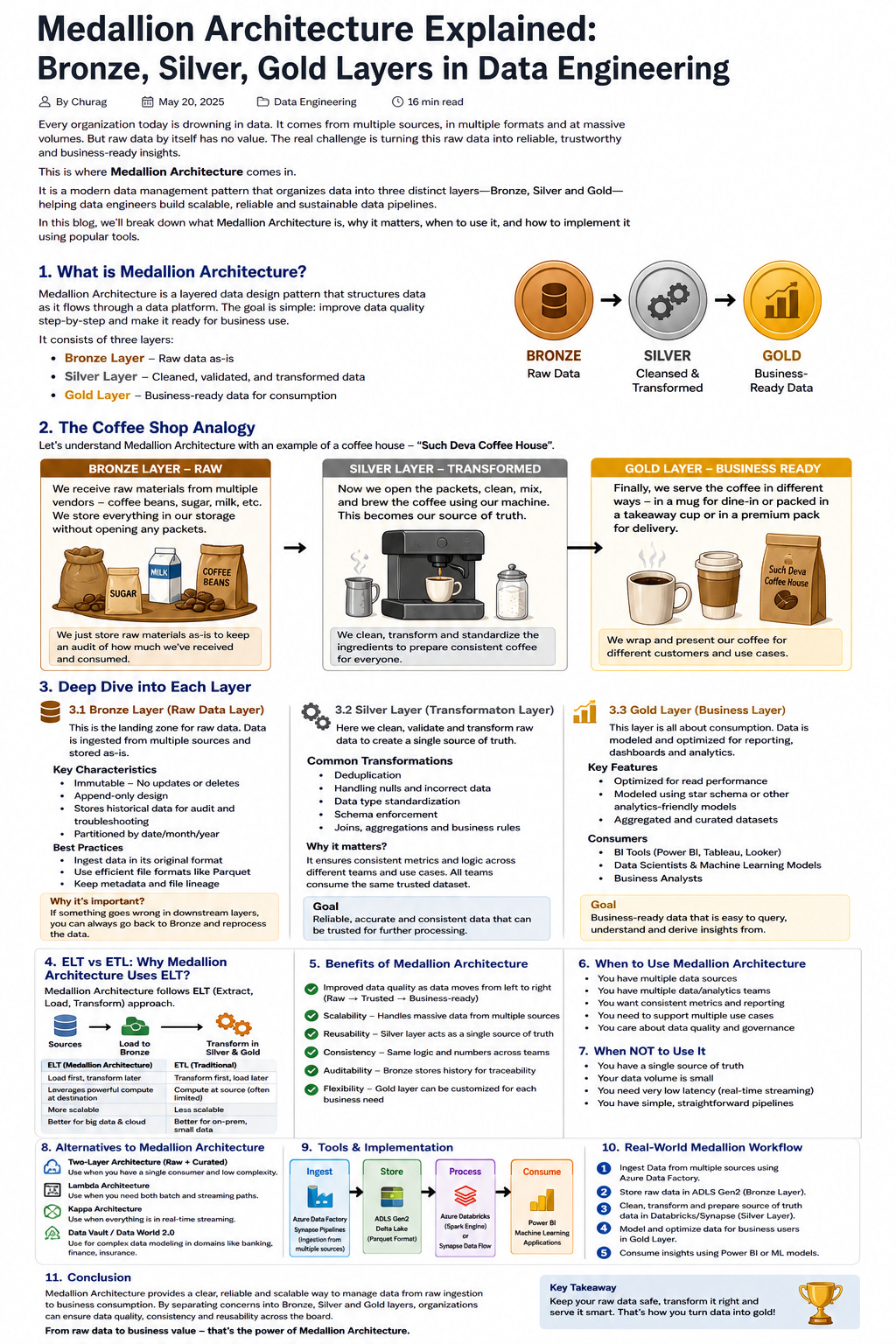
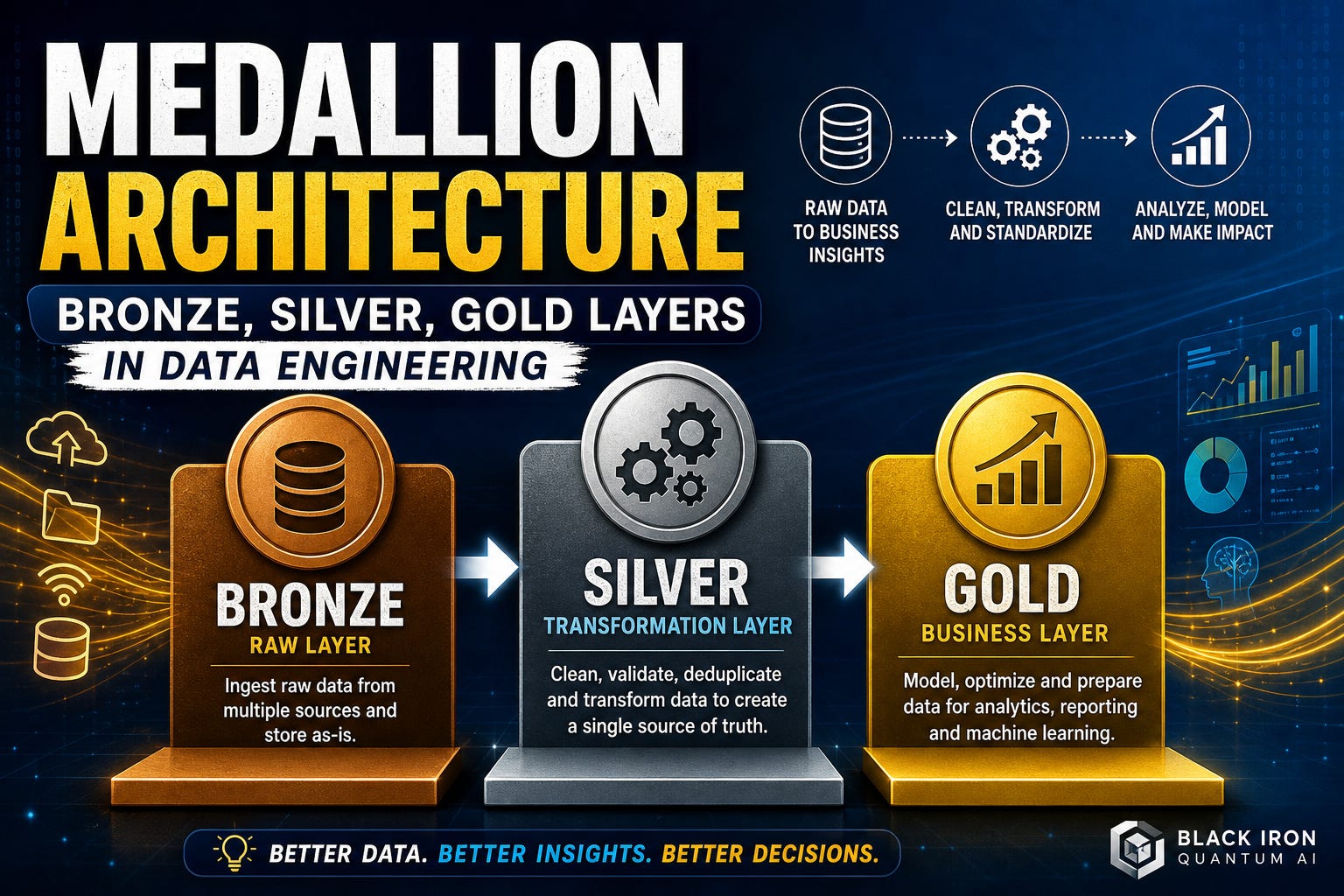
Medallion Architecture is a layered approach to data processing that structures data into three stages:
Bronze Layer → Raw data
Silver Layer → Cleaned and transformed data
Gold Layer → Business-ready data
The core idea is simple:
👉 Improve data quality step-by-step as it flows through each layer.
Instead of transforming data all at once, this approach allows teams to build reliable, scalable, and reusable data pipelines.
The Coffee Shop Analogy
To make this concept intuitive, imagine a coffee shop.
☕ Bronze Layer (Raw Ingredients)
You receive:
Coffee beans from one vendor
Milk from another
Sugar from a third
You store everything as-is. You don’t open or process anything yet.
☕ Silver Layer (Brewing Process)
Now, you:
Open the ingredients
Clean and measure them
Brew coffee using a machine
This is where raw materials become usable.
☕ Gold Layer (Serving Customers)
Finally, you:
Serve coffee in mugs for dine-in
Pack it in takeaway cups
Customize it for different customers
This is your final, consumable product.
👉 Just like coffee, data becomes more valuable as it moves through these stages.
Bronze Layer (Raw Data Layer)
The Bronze layer is the entry point of your data pipeline.
Key Characteristics:
Stores data exactly as received
No transformations applied
Immutable (no updates or deletions)
Append-only design
Why It Matters:
Acts as a historical record
Enables auditing and traceability
Allows you to reprocess data anytime
Best Practices:
Partition data by date (day/month/year)
Store in efficient formats like Parquet
Keep it as close to the source as possible
👉 Think of it as your “data backup with history.”
Silver Layer (Transformation Layer)
The Silver layer is where data becomes clean, structured, and reliable.
What Happens Here:
Data cleaning
Deduplication
Handling missing values
Data type corrections
Schema enforcement
Joining multiple datasets
Purpose:
This layer acts as a Single Source of Truth.
Instead of each team applying their own logic, everyone uses the same standardized dataset.
Why It’s Critical:
Without a Silver layer:
Different teams may calculate metrics differently
Results become inconsistent
Trust in data decreases
👉 Silver ensures consistency across the organization.
Gold Layer (Business Layer)
The Gold layer is designed for consumption.
Key Features:
Optimized for fast queries
Structured for business use cases
Aggregated and refined datasets
Common Techniques:
Star schema modeling
Pre-aggregated tables
Business-specific data marts
Who Uses It:
BI tools (dashboards)
Analysts
Machine learning models
👉 This is where data turns into insights and decisions.
ELT vs ETL: Why Medallion Uses ELT
Traditional pipelines follow ETL (Extract → Transform → Load).
Medallion Architecture follows ELT (Extract → Load → Transform).
Why ELT Works Better:
Stores raw data first (no data loss)
Enables reprocessing anytime
Scales better with modern cloud systems
👉 You load first, then refine step-by-step.
Benefits of Medallion Architecture
✔ Improved Data Quality
Data becomes cleaner as it moves through layers
✔ Scalability
Handles large volumes of data efficiently
✔ Reusability
Same data can serve multiple use cases
✔ Consistency
All teams rely on the same source of truth
✔ Easier Debugging
Issues can be traced back to earlier layers
When Should You Use Medallion Architecture?
Use it when:
You have multiple data sources
Multiple teams depend on data
You need consistent reporting
Data is used across departments
When NOT to Use It
Avoid it when:
You have a single data source
Your pipeline is simple
You need real-time, low-latency processing
👉 Medallion introduces multiple steps, which can add latency.
Alternative Architectures
If Medallion isn’t suitable, consider:
🔹 Two-Layer Architecture
Raw + Curated
Simpler, but less flexible
🔹 Lambda Architecture
Supports batch + streaming
🔹 Kappa Architecture
Focuses entirely on streaming
🔹 Data Vault
Used for complex enterprise systems (e.g., finance, banking)
Tools & Implementation
A typical Medallion setup may include:
Data Ingestion
Tools to collect data from multiple sources
Storage
Data lakes (Parquet, Delta formats)
Processing
Distributed engines for transformations
Consumption
BI tools and analytics platforms
👉 The exact tools depend on your scale and use case.
Real-World Workflow Example
Here’s how a typical pipeline works:
Ingest data → Store in Bronze
Clean & transform → Move to Silver
Model & optimize → Publish to Gold
Consume → Use in dashboards or ML
Conclusion
Medallion Architecture provides a clear, scalable way to manage data from raw ingestion to business insights.
By separating data into Bronze, Silver, and Gold layers, organizations can:
Improve data quality
Ensure consistency
Enable reuse across teams
At its core, it’s about one simple idea:
👉 Turn raw data into reliable, business-ready insights—step by step.